
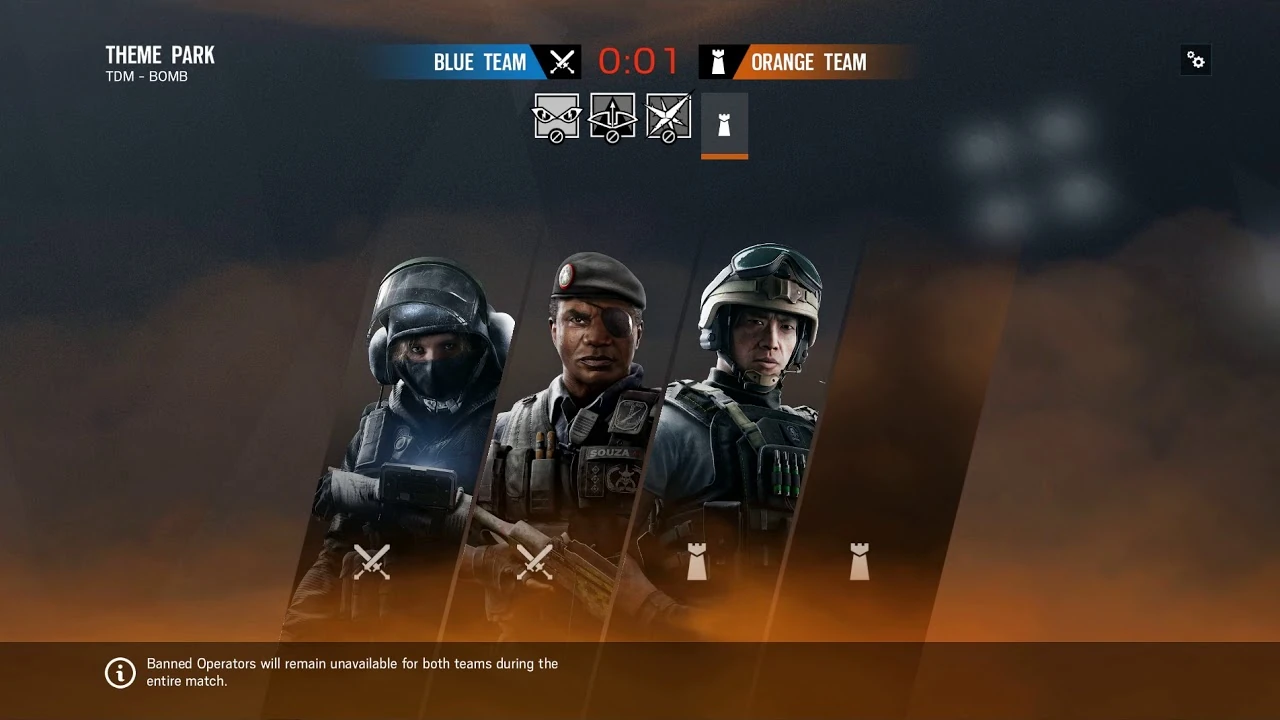
Pick and Ban is a rule in the Ranked and Unranked playlists, or custom gamemode option. It allows each team the right to ban operators, and prevent that operator from being picked for the game.[1]
It is introduced in Tom Clancy's Rainbow Six Siege in the Operation Para Bellum expansion, and received a rework in the Operation Daybreak expansion.
Mechanic[]
In Ranked and Unranked, the Pick and Ban phase is commenced for each round played, except during the Overtime rounds. It takes place right before each team picks their Location and Operators. Up to three Operators on each side can be banned, with the number of ban increasing gradually as the match progress.
In custom games, as there are more than three rounds, the Pick and Ban phase is not commenced for every round.
The process of Pick and Ban Phase commences at the same time for both teams.
The Vote to Ban[]
Each player votes for up to one operator of the opposing side, or "NO BAN". The votes that are cast are counted in a tally, noted by a number at the voted operator's icon, or "NO BAN".
The Pick and Ban phase is 15 seconds long. Each player must make their decision within this time limit, or they are considered to have abstained from the process. Votes that are cast cannot be withdrawn, but can be freely changed between any choices while the timer lasts.
At the end of the timer, the tally is finalized, and the result is announced to both teams and applied before proceeding with the round.
Simply put: The Attackes ban a Defender AND The Defenders ban an Attacker.
Determination of Ban Result[]
The team's ban decision is based on the majority vote. Abstained votes are excluded from vote calculations, even if it was the team's majority (more abstained players than voting players).
Thus, the result can be summarized as follow:
- If only one Operator is the team's majority (received the most vote), that Operator is banned.
- If "NO BAN" is the team's Majority Vote, or all players on the team have abstained, then no Operators are banned.
- If more than one choice, including "NO BAN", have the same number of vote(s), one of the choices is chosen at random to be the team's decision.
Application of Ban Results[]
The result of a ban is immediately applied: Players of the opposing team cannot choose the banned operator to play. This lasts until the side changes.
Ban Clearing[]
Once the side switch, all bans are cleared, and the teams have to ban the opposing operators again.
All bans each team have imposed on the opposing team do not come back to affect the imposing team. However, the opponent may choose to ban the same operator, and reenact the ban.
Overtime[]
If a game of Ranked or Unranked reach Overtime, the Pick and Ban phase is no longer commenced. Instead, the three bans that each team had imposed during the Normal Rounds are now applied again.
The attacking team applies their previous bans on Defender Operators, and the defending team applies their previous bans on Attacker Operators. And with the side switch, both teams get to apply both sets of the ban at least once.
Example: Flow in Ranked and Unranked Game[]
For Ranked and Unranked games, the ban can be exemplified in teh following flows:
- 1. For the first round, there is now one banned operator on each side.
- 2. For the second round, there are two banned operators on each side. (The ban from the previous round is applied.)
- 3. For the third round, there are now three banned operators on each side. (The bans from the previous two rounds are also applied.)
- At this point, the side switches. Bans that each team had applied are cleared.
- 4. For the fourth round, there is now one banned operator on each side.
- 5. For the fifth round, there are now two banned operators on each side.
- 6. For the sixth round, there are now three banned operator on each side.
- At this point, the game proceeds into Overtime. Bans that each team had applied are now reinstated, based on the side they are on.
- 7. For the seventh round, the bans each team have applied on the opposition (while they were attacking or defending) are applied again. (The attacker ban by the defending team, and the defenders ban by the attacking team, are applied again)
- 8. For the eighth round, with the side switch, the ban roster changes to be the ban roster of the opposing side.
- 9. For the ninth and final round, with the side switching back to the same as the seventh round, the bans are the same as the seventh round.
Original Iteration[]
- NOTE: The information in this section has since been rendered obsolete, and is listed for historical purpose only.
In Ranked or Unranked, the Pick and Ban Phase was commenced directly after the Map Ban Phase. the order of Pick and Ban were as follow:
- The Defending team picks one Attacker Operator.
- The Attacking team picks one Attacker Operator.
- The Attacking team picks one Defender Operator.
- The Defending team picks one Defender Operator.
The team may also vote "NO BAN" in place of any operator.
Each team member had 30 seconds to cast their vote. Each member of the team may choose an operator, "NO BAN", or abstain from the vote entirely. Abstained votes are excluded from vote calculations, even if it was the team's majority.
At the end of the timer, the choice with the most vote was selected to be banned. If "NO BAN" was the team's majority choice, no operator would be banned. In case of a tie between two or more lead choices, one of the choices was randomly selected to be banned.
All bans affected both teams, and lasted for the entire match.
This mechanic had since been reworked with the release of Operation Daybreak.
| |||||||||||||||||||||||